Why High-Speed Machines Reduce Manufacturing Complexity
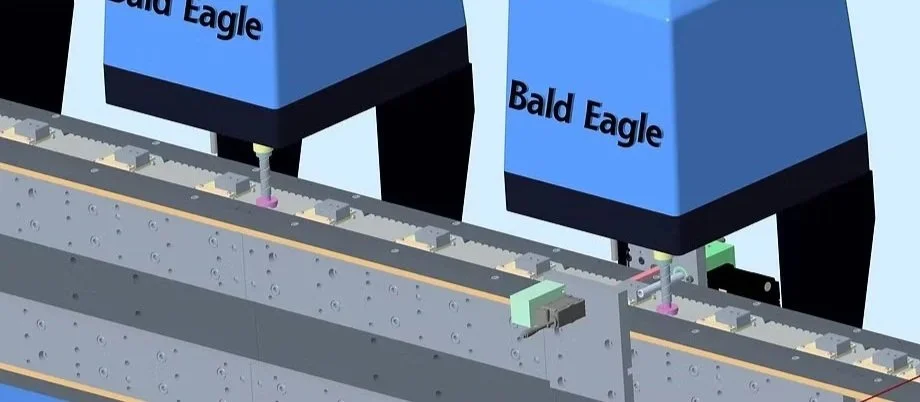
Many manufacturers increase throughput by adding equipment. When production requirements increase, the typical response is to add more assembly stations, more feed systems, more tooling, more conveyors, and sometimes more machines. The goal is understandable: increase output.
The problem is that every additional component introduces complexity.
Every sensor, actuator, feeder, conveyor, and assembly station has a finite reliability. Every component requires maintenance. Every component consumes floor space. Every component introduces another opportunity for variation, downtime, or failure.
There is another approach.
Increase machine speed.
At Blur Machine Laboratory, we believe that higher throughput is often best achieved through faster machines rather than more machines.
Throughput Without Multiplication
Consider two different manufacturing strategies.
The first approach uses multiple slower machines or multiple parallel processes to achieve a desired production rate.
The second approach uses a smaller number of high-speed systems capable of producing the same output.
On paper, both approaches may achieve similar throughput. In practice, the outcomes are often very different.
When equipment multiplies, complexity multiplies with it.
Additional machines require additional maintenance schedules. More tooling requires more setup and adjustment. More stations introduce more opportunities for variation. More equipment occupies valuable floor space and increases the cost of ownership throughout the life of the system.
A faster machine can often eliminate much of that complexity.
Complexity Has a Cost
Manufacturing teams are often focused on the purchase price of equipment. The larger cost is frequently incurred after installation.
Every piece of equipment must be operated, maintained, inspected, repaired, and eventually replaced.
As production systems become more complex, the number of potential failure points increases. Troubleshooting becomes more difficult. Downtime events become more frequent. Spare parts inventories become larger.
The result is a production environment that requires more resources simply to maintain existing performance.
Reducing equipment count can reduce many of these costs simultaneously.
Fewer machines often means fewer operators, fewer maintenance requirements, fewer spare parts, and fewer opportunities for unexpected downtime.
Reliability Improves When Simplicity Improves
Reliability is often viewed as a component-level problem.
In reality, reliability is frequently a system-level problem.
A production line may contain hundreds or thousands of individual components. Even highly reliable components contribute to overall system risk when enough of them are combined together.
This is one reason that simpler systems often outperform more complicated systems over the long term.
Reducing the number of stations, mechanisms, and supporting systems can improve overall uptime and reduce operational disruptions.
The objective is not simply to make machines faster.
The objective is to make manufacturing systems more effective.
High machine speeds create opportunities to simplify production architecture while maintaining or increasing output.
Product Quality Benefits From Simplicity
Complexity affects more than reliability. It also affects quality.
When manufacturers perform assembly operations on multiple products simultaneously, additional variation is often introduced into the process.
Positioning variation, tooling variation, alignment variation, and process variation can all increase as systems become more complex.
In many applications, simpler tooling and faster machine operation can produce more consistent results.
The goal is not speed for its own sake.
The goal is maintaining precision while achieving high throughput.
A well-designed high-speed system can often accomplish both.
Speed Creates Competitive Advantage
Manufacturing is ultimately a competitive business.
Companies that can produce more efficiently, maintain higher quality, reduce downtime, and lower operating costs gain an advantage in the marketplace.
Machine speed is one way to achieve that advantage.
A high-speed system can increase throughput while reducing equipment requirements. It can improve reliability while simplifying operations. It can reduce floor space requirements while lowering long-term ownership costs.
These benefits extend beyond engineering.
They affect profitability.
A Different Way to Think About Throughput
For decades, many manufacturers have approached throughput challenges by adding equipment.
Sometimes that is the right solution.
Often, it is not.
Before multiplying machines, tooling, and process complexity, it is worth asking a different question:
Can the same result be achieved with a faster machine?
At Blur Machine Laboratory, that question drives everything we do.
We specialize in high-speed manufacturing systems designed to increase throughput, reduce complexity, improve reliability, and create lasting competitive advantages for manufacturers.
Sometimes the fastest path to higher production is not more equipment.
Sometimes it is simply more speed.
Have a Manufacturing Challenge?
Blur Machine Laboratory specializes in high-speed machine design, custom automation, and turnkey manufacturing solutions.
Contact us to discuss your requirements ➔